What's inside
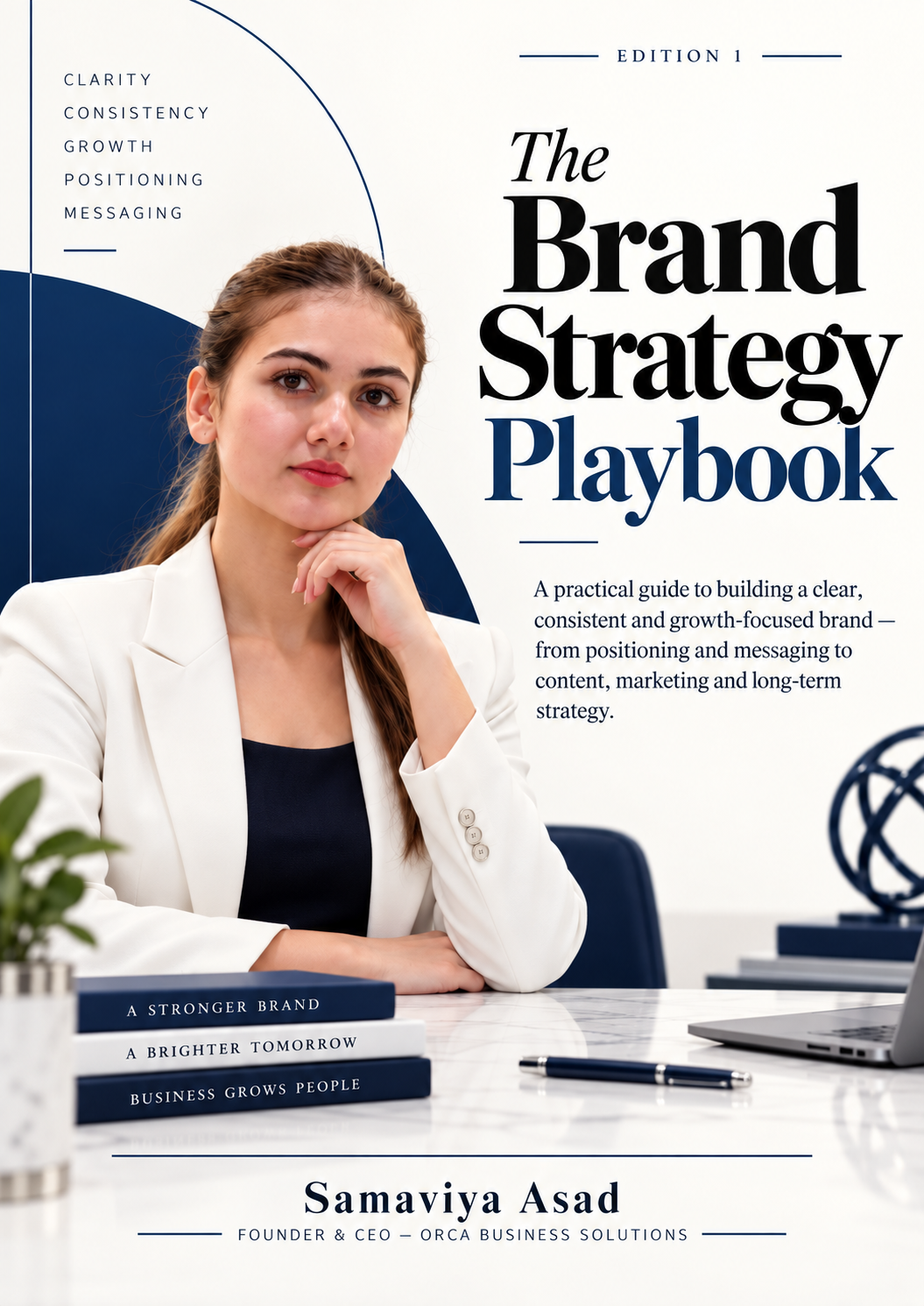
Samaviya Asad
Samaviya Asad is a young entrepreneur, marketing strategist, communications professional and business development specialist with extensive experience in digital media, public relations, influencer marketing and brand strategy.
Her approach combines strong storytelling with practical business strategy — helping brands not only look good online, but build the systems, communication and strategies that support long-term growth. As Founder & CEO of Orca Business Solutions, she leads a team that brings strategy, creative, PR, production and digital together under one roof.
Areas of expertise
Digital Marketing
Channel strategy and campaigns built to convert, not just reach.
Social Media Strategy
Turning platforms into consistent, on-brand growth engines.
Public Relations
Earned trust, media relations and reputation management.
Influencer Marketing
Creator partnerships that actually perform.
Brand Strategy
Positioning, messaging and identity built to last.
Business Development
Connecting brand and marketing to real revenue.
Campaign Management
End-to-end execution across teams and channels.
Content Strategy
Content systems that compound over time.
Creative Direction
A consistent look, voice and feel everywhere.
My goal with this playbook is simple: give founders and teams the same clear, practical thinking we use with clients every day — so you can build a brand that's designed to grow.
Introduction — Why Brand Strategy Matters
Most businesses don't have a branding problem. They have a strategy problem. They have a logo, a colour, a few social accounts — but no clear answer to the questions that actually drive growth: who are we for, what do we stand for, and why should anyone choose us?
A brand strategy is the plan that answers those questions and keeps everyone — you, your team, your agency — pulling in the same direction. Without it, every campaign starts from scratch, every designer interprets you differently, and customers struggle to remember what you do. With it, every rupee you spend compounds, because it all reinforces the same clear idea.
What a brand strategy is (and isn't)
| A brand strategy IS | A brand strategy is NOT |
|---|---|
| A clear decision about who you serve and why | Just a logo or colour palette |
| A consistent message and personality | A one-off campaign |
| A system your whole team can follow | Something only the marketing team owns |
| A long-term asset that compounds | A quick fix for slow sales |
Brands with a clear strategy spend less to acquire customers, charge more for the same product, and keep customers longer. Strategy isn't a cost — it's what makes everything else cheaper.
This playbook walks through building that strategy step by step. Read it straight through the first time, then use the checklists and the 30-day plan at the end to put it to work.
Brand vs Branding vs Marketing
These three words get used interchangeably, and that confusion is expensive. They're related but different — and knowing the difference is one of the cheapest ways to make your budget work harder.
Brand
The perception in people's minds — what they think and feel about you. You influence it, but you don't fully own it.
Branding
The deliberate work of shaping that perception: identity, voice, values, experience.
Marketing
The channels and tactics that communicate the brand and drive action: ads, content, social, SEO.
Put simply: your brand is the reputation, branding is the work of building it, and marketing is how you spread it. Branding answers "who" and "why." Marketing answers "how."
The order matters. Marketing on top of a confused brand wastes money, because nothing reinforces anything else. Get the brand clear first, and every marketing rupee starts working harder.
Building a Strong Brand Foundation
A brand foundation is the small set of decisions everything else is built on. Get these right and your positioning, messaging and visuals almost write themselves.
The five foundation pillars
Purpose
Why you exist beyond making money.
Audience
The specific people you serve best.
Positioning
The space you own in their mind.
Personality
How you look, sound and behave.
Promise
The value you consistently deliver.
Write one sentence for each pillar. If you can't, that pillar is your next priority. A foundation you can state in five sentences is stronger than a 40-page brand book nobody reads.
The rest of this playbook builds each pillar in turn. Don't skip ahead — clarity compounds.
Brand Purpose, Mission & Vision
Purpose, mission and vision are often treated as fluffy wall-art. Done well, they're decision-making tools — they tell you what to say yes and no to.
| Element | Answers | Time frame |
|---|---|---|
| Purpose | Why do we exist? | Timeless |
| Mission | What do we do, for whom, today? | Present |
| Vision | Where are we going? | Future |
How to write them without the fluff
- Purpose: finish the sentence "We exist so that…" — focus on the customer's world, not your product.
- Mission: "We help [audience] achieve [outcome] through [what you do]."
- Vision: describe the change you want to see in 5–10 years if you succeed.
Purpose: So that small businesses get access to strategy that used to be reserved for big budgets. Mission: We help growing businesses build brands and marketing systems that drive real growth. Vision: A market where great businesses win on clarity, not just spend.
Understanding Your Target Audience
You can't build a brand for everyone. The sharper your picture of who you serve, the sharper everything downstream becomes — message, channels, content, tone.
Go beyond demographics
Age and location tell you almost nothing about why someone buys. Focus on the things that actually drive decisions:
Goals
What are they trying to achieve or become?
Pains
What frustrates them about the current options?
Triggers
What event makes them start looking?
Objections
What makes them hesitate before buying?
Build one sharp persona
A single sharp sentence beats a vague crowd. "Busy clinic owners who want more bookings without managing ads themselves" tells you more than "adults 25–55."
Talk to five real customers. Ask what they were doing right before they found you, and what almost stopped them from buying. Their words become your best marketing copy.
Brand Positioning
Positioning is the space you own in your customer's mind relative to the alternatives. It's not what you say about yourself — it's the one thing you want to be known for.
The positioning statement
For [target audience] who [need/situation], [your brand] is the [category] that [key benefit] — because [reason to believe].
Find your angle
Strong positioning usually leans on one of these. Pick one to lead with — trying to own all four owns none:
Different
You do something rivals don't.
Better
You do the same thing, clearly better.
Focused
You serve one niche exceptionally well.
Trusted
You're the safe, credible choice.
Creating Your Unique Value Proposition
Your value proposition is the promise that makes someone choose you in the few seconds they spend deciding. It lives on your homepage, your profiles and the tip of your team's tongue.
A strong UVP has three parts
The outcome
The result the customer actually wants.
The differentiator
Why you deliver it better or differently.
The proof
Evidence that you can — results, guarantees, credentials.
Weak: "We provide quality digital marketing services." Strong: "We turn scattered marketing into one growth system — strategy, creative and campaigns under one roof, with reporting you can actually read."
- It names a real outcome, not a feature.
- It says why you, not just what you do.
- A stranger understands it in one read.
Brand Personality & Tone of Voice
If your brand were a person, how would they speak? Personality is what makes you recognisable across every caption, email and reply — long before anyone sees your logo.
Define your traits
Choose three to four personality traits and a "we are / we are not" for each. Constraints create consistency.
| We are | We are not |
|---|---|
| Clear | Jargon-heavy |
| Confident | Arrogant |
| Warm | Overly casual |
| Practical | Salesy |
Turn traits into a voice
- Set rules for tone by context (a sales page vs a support reply).
- Keep a short list of words you use — and words you avoid.
- Write 3–4 example lines so anyone can match the voice.
Tone flexes; voice stays constant. You can be playful on social and serious in a proposal, but it should still sound like the same brand.
Brand Messaging Framework
A messaging framework is your single source of truth for what to say. It stops every team member from reinventing the pitch and keeps you consistent across channels.
The message hierarchy
Core message
One sentence that captures your promise.
Value pillars
Three themes that support it (e.g. clarity, one team, real results).
Proof points
Evidence under each pillar — results, testimonials, process.
Everyday copy
How it shows up in headlines, bios and posts.
Everything you publish should ladder back to the core message. If a post doesn't reinforce a pillar, ask why you're posting it.
Visual Brand Identity
Visual identity is how your brand looks — and its job is recognition and consistency, not decoration. The best identities are simple enough to apply everywhere and distinct enough to remember.
The core kit
Logo
Primary, secondary and a mark for small spaces.
Colour
A tight palette with clear roles and accessible contrast.
Type
One or two typefaces with a defined scale.
Imagery
A consistent style for photos and graphics.
Layout
Spacing, grids and how elements sit together.
Assets
Icons, patterns and templates for reuse.
Constraint beats variety. A brand that uses two colours and one font everywhere looks far more premium than one using ten of each.
Document these in a short, usable guide — a few pages people actually open beats a 60-page manual nobody does.
Storytelling for Brands
Facts inform; stories persuade and stick. Brand storytelling isn't about drama — it's about framing what you do in a way people care about and remember.
The simplest story structure
The customer is the hero
Not you. Start with their goal and problem.
You are the guide
You have the plan and the experience to help.
The plan
Show the clear path from problem to result.
The transformation
Paint the after — who they become once it works.
Rewrite your homepage headline so the customer is the hero and you're the guide. It usually doubles the clarity instantly.
Content Strategy
Content is how your brand shows up between sales. A content strategy turns random posting into a system that builds trust and brings in demand over time.
The three jobs of content
Attract
Get found by people who don't know you yet — SEO, social, video.
Nurture
Prove you can help — guides, cases, behind-the-scenes.
Convert
Make the next step easy — offers, demos, consultations.
Make it sustainable
- Pick a few formats you can maintain, not all of them.
- Batch and repurpose — one idea becomes an article, a video and several posts.
- Keep a simple monthly calendar tied to your value pillars.
Consistency beats intensity. Publishing something useful every week for a year beats a burst that burns out in a month.
Social Media Brand Strategy
Social media is where people check whether you're real and worth their time. The goal isn't to be everywhere — it's to be consistent and recognisable where your audience actually is.
A simple social plan
Choose 1–2 platforms
Where your audience already spends attention.
Define content pillars
3–4 recurring themes tied to your brand message.
Set a realistic rhythm
A cadence you can hold for months, not weeks.
Engage, don't just broadcast
Reply, start conversations, build relationships.
Vanity metrics (likes) feel good; business metrics tell the truth. Watch saves, shares, profile visits, DMs and clicks — the signals that show real interest.
PR & Brand Reputation
Public relations is how your story reaches the world through voices other than your own. For most businesses, earned trust is worth more than any ad.
PR for brands, practically
- Have a clear, repeatable brand story before you pitch anyone.
- Build relationships with relevant media and communities — not one-off asks.
- Use press releases for genuine news; use your own channels for the rest.
- Prepare for the bad days — a simple response plan protects years of goodwill.
Local and niche media are far more accessible than national outlets — and often more relevant to the customers you actually want.
Influencer Marketing Strategy
Influencer marketing works when it's a brand partnership, not a transaction. The right creator lends you their trust with an audience you want to reach.
Get it right
Fit over follower count
Relevance and trust beat raw reach. Micro-creators often convert better.
Brief for performance
Share the goal, the message and the freedom — not a rigid script.
Let them sound like themselves
Their voice is why the audience listens.
Measure what matters
Track saves, clicks, codes and conversions, not just views.
Fake or inflated audiences are common. Check engagement quality and audience location before you pay for reach that isn't real.
Customer Experience & Brand Trust
Your brand isn't what you say — it's what customers experience. Every touchpoint either builds or erodes trust, and trust is the real currency of a brand.
Map the journey
Walk through your own brand as a customer: discovery, first contact, buying, using, support, and coming back. Fix the moments that feel confusing, slow or off-brand.
Before
Is it easy to find and understand you?
During
Is buying smooth and reassuring?
After
Do you follow through and stay in touch?
Consistency across these moments is what turns a first purchase into loyalty, referrals and reviews — the cheapest growth there is.
Building Brand Consistency
Consistency is what turns scattered activity into a recognisable brand. It's less glamorous than a rebrand, but it's where most of the value is created.
- One message: everyone can state what you do the same way.
- One voice: your website, social and ads sound like the same brand.
- One look: colours, type and imagery match everywhere.
- One experience: the promise holds from first click to after-sale.
Make consistency easy
People aren't inconsistent on purpose — they lack tools. Templates, a short brand guide and a shared asset library remove the friction that causes drift.
Audit yourself twice a year: line up your homepage, top three posts and a recent proposal side by side. Do they look and sound like one brand?
Brand Growth Strategy
A brand is an asset that should compound. Growth comes from deepening what works before chasing what's new — and from making your brand and marketing repeatable.
Grow in this order
Strengthen the core
Sell more to existing customers through trust and retention.
Sharpen the target
Win more customers like your best ones.
Expand the offer
Add products or services for the audience you have.
Enter new ground
New markets or segments — once the core is solid.
Campaigns create spikes; systems create growth. Turn your best-performing marketing into a monthly rhythm so growth doesn't depend on heroics.
As you scale, protect what got you here — quality and experience — so growth builds the brand instead of diluting it.
Common Branding Mistakes
Most branding problems aren't dramatic — they're quiet, avoidable and expensive. Here are the ones we see most often.
| Mistake | Fix |
|---|---|
| Trying to appeal to everyone | Choose a specific audience and own it |
| Confusing a logo with a brand | Build the strategy behind the visuals |
| Inconsistent look and voice | Create a short brand guide and templates |
| Copying competitors | Lead with what makes you different |
| Marketing before positioning | Get the message clear first |
| Chasing trends over identity | Stay recognisable; adapt the tactics, not the brand |
| No way to measure | Track a few metrics that connect to revenue |
Treating branding as a one-time project instead of an ongoing discipline. Brands are built — and maintained — over time.
Brand Strategy Checklist
Use this as a health check. If you can tick every box, your brand is in strong shape. Every unticked box is a priority.
Foundation
- We can state our purpose, mission and vision in one sentence each.
- We know exactly who we serve best.
- We have a clear positioning statement.
Message & identity
- We have a one-line value proposition.
- We've defined our personality and tone of voice.
- We have a messaging framework everyone uses.
- We have a documented visual identity.
Presence & growth
- Our content is tied to a strategy, not random.
- We're consistent across website, social and ads.
- We manage our reputation and PR deliberately.
- We track a few metrics that connect to revenue.
- We have a plan to grow the brand over time.
30-Day Brand Action Plan
Strategy only matters when it's applied. Here's a focused month to move your brand from vague to clear. One theme per week.
| Week | Focus | Outcome |
|---|---|---|
| Week 1 | Foundation & audience | Purpose, mission, vision and one sharp persona written down. |
| Week 2 | Positioning & message | A positioning statement, value proposition and messaging framework. |
| Week 3 | Identity & voice | A tightened visual kit and a documented tone of voice. |
| Week 4 | Content & consistency | A simple content plan and a brand consistency audit. |
Daily rhythm that makes it stick
- Spend 30–45 focused minutes a day on that week's theme.
- End each week by writing down what you decided — decisions, not drafts.
- Share each week's output with your team so the brand lives beyond you.
You'll have a brand strategy on paper that any team member or partner can follow. That single document will make every future marketing decision faster and cheaper.
Final Thoughts
A strong brand isn't built in a launch — it's built in a thousand consistent decisions. The strategy in this playbook is what makes those decisions easy and aligned.
You don't need a big budget to build a great brand. You need clarity, consistency and the discipline to keep reinforcing the same clear idea. Start with the foundation, work through the framework, and let it compound.
If you take one thing from this guide, take this: decide who you're for and what you stand for — then repeat it, everywhere, for a long time. That's brand strategy.
How Orca Business Solutions can help
Everything in this playbook is what we do with clients every day. Orca Business Solutions is a full-service partner that brings strategy, creative, communication and growth together under one roof — so the pieces actually work as a system.
Brand Strategy
Positioning, messaging, purpose and identity built to last.
Marketing
Channel strategy and campaigns designed to convert.
Public Relations
Earned trust, media relations and reputation management.
Digital Media
Social, SEO, web and paid working as one funnel.
Content & Creative
Content systems and creative direction that stay on-brand.
Business Development & Growth
Connecting brand and marketing to real revenue.
When strategy, creative, PR and digital sit in separate silos, they drift. Under one roof, every piece reinforces the same clear brand — and that's what compounds into growth.
Book a consultation with Orca Business Solutions and we'll turn this playbook into a plan for your business.
Book a Consultation →orcabusiness.solutions · hello@orcabusiness.solutions